

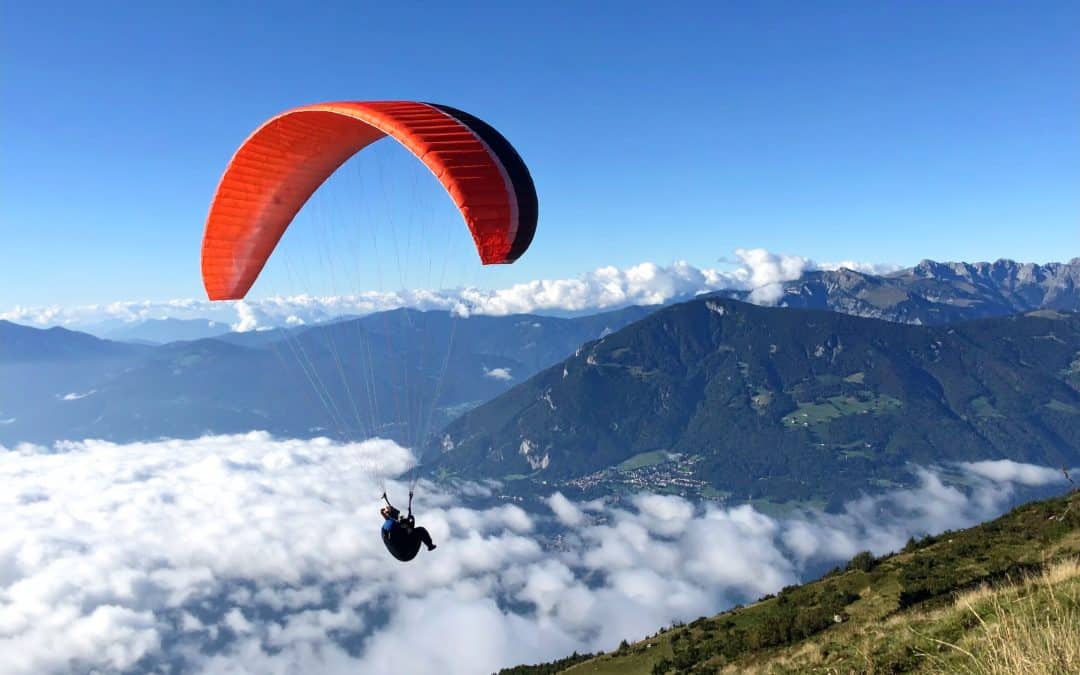
The lifespan of a paragliding wing depends primarily on its maintenance.
Have you just acquired a new wing or are you looking to extend the life of your current equipment? At TheGlidery, we know how precious your paragliding gear is, both emotionally and financially. Whether you’re a paraglider rental enthusiast for occasional getaways or a passionate owner, understanding how to properly maintain your wing is essential to guarantee its longevity and maintain optimal performance over the years. In this article, we’ll share all our expert secrets to keep your wing in perfect condition, flight after flight.
The lifespan of a paragliding wing according to TheGlidery: myths and realities
Let’s start by dispelling a few misconceptions. You may have heard that a paragliding wing has a fixed lifespan of 5 years or 300 flight hours. In reality, it’s much more complex! At TheGlidery, our experience in paragliding rentals has taught us that the longevity of a wing depends on many factors: the initial manufacturing quality, the conditions in which you fly, but above all, how well you take care of it.
A well-maintained wing can easily exceed 500 flight hours while maintaining excellent performance and optimal safety. Some high-end models can even reach 700 to 800 hours if treated with care and attention. Conversely, a mistreated wing can see its performance degrade significantly after only 150 hours.
The invisible enemy: UV rays and how TheGlidery advises you to protect yourself.
Paradoxically, the sun is a paraglider’s best friend and their equipment’s worst enemy. Ultraviolet rays gradually degrade the fabric of your wing, weakening its strength and porosity. This is one of the main factors in aging, and unfortunately, this degradation is irreversible.
The good news? Simple actions can significantly reduce this problem. After each flight, pack your wing back in its bag as soon as possible instead of leaving it unfolded on the landing area while you chat with friends. If you have to wait at the launch site, use your harness or carrying bag to cover the wing. At TheGlidery, we also advise all our paragliding rental customers to avoid drying their wing in direct sunlight, even if it’s damp. A shaded but well-ventilated spot is always preferable.
Some manufacturers now offer fabrics with UV protection, but even these high-tech fabrics require special care. During our personalized consultations, we often recommend using lightweight protective covers specifically designed for extended inflation sessions or waiting periods during takeoff.
Humidity and mold: TheGlidery’s tips for perfect drying
While UV rays are the number one enemy, humidity comes in second in the ranking of threats to your wing. A damp wing stored in its bag can develop mold in just a few days, especially in warm weather. These microorganisms don’t just stain the fabric; they attack it and weaken it permanently.
Even if you’re in a hurry after a flight, take a few minutes to unfold your wing in a dry place before putting it away for good. If you flew in the rain or landed on wet grass, thorough drying is essential before any extended storage. Ideally, hang your wing in a well-ventilated room, out of direct sunlight.
Our expert tip from TheGlidery? If you have to store your wing while it’s still slightly damp, don’t compress it in its bag. Instead, leave it loosely folded and take it out to dry as soon as possible, ideally within 24 hours. This simple precaution will prevent the development of mold that could compromise the lifespan of your precious paragliding equipment.
Smart folding: TheGlidery method that preserves your wing
Folding isn’t just a practical matter for packing your wing in its bag; it’s a true protective ritual that directly influences its lifespan. Repeated folds in the same place create weak points in the fabric and can damage the battens, the reinforcements that give your wing its optimal aerodynamic shape.
To avoid this problem, adopt an alternating folding system. One day, start by folding the left wingtip towards the center, the next day, start with the right wingtip. This simple habit will distribute wear more evenly across the entire sail.
At TheGlidery, we train all our partners who manage our paragliding rental service in this folding technique. We also recommend not over-compressing your wing in its bag. A slightly larger bag where the wing is less compressed is preferable for the equipment’s lifespan.
Special attention should be paid to models with plastic ribs or rigid reinforcements. These elements must be folded carefully to avoid creases that could permanently damage them. If your wing has ribs, we advise you to consult the manufacturer’s manual, which usually details the recommended folding method specifically for that model.
Suspension lines: these wires deserve your attention, according to TheGlidery
The lines are the lifeblood of your paraglider, connecting the wing to the harness and transmitting your piloting commands. They are subjected to considerable stress and deserve special attention.
After each flight, make it a habit to visually inspect your wing’s lines. Look for signs of wear such as frayed sheaths, exposed cores, or knots. Unsheathed lines are particularly vulnerable and can be damaged by contact with rough surfaces, such as rocks or vegetation.
To minimize wear and tear, avoid dragging your wing along the ground during handling. When taking off, lift your wing rather than pulling it across the ground. This simple habit can significantly extend the lifespan of the lower lines, which are most often in contact with the ground.
If you’re storing your wing for an extended period, such as during the winter for those who don’t practice winter soaring, make sure the lines aren’t under tension. A light elastic band to hold the risers together is sufficient, but avoid tightening it too much to prevent deforming the lines.
At our paragliding rental center, TheGlidery, we systematically check the lines between each rental, and we recommend that all pilots have their wing lines measured at least once a year or every 100 flight hours. Excessive stretching or shortening can affect not only the performance but also the safety of your wing.
Ground inflation: an essential but tiring practice according to TheGlidery
Ground inflation is essential for improving your takeoff technique and your feel for the wing. In fact, it’s what we recommend to all pilots who choose our paragliding rental service when getting to grips with a new model. However, this activity can be particularly hard on your equipment if it’s not done correctly.
Repeated launches and landings of the paraglider, often on abrasive surfaces, cause accelerated wear and tear on the fabric and lines. To minimize this impact, choose a clean, clear area, ideally grassy, for your ground handling sessions. Avoid surfaces with abrasive elements such as gravel or twigs.
A little-known tip is to use a dedicated ground handling wing if you practice this exercise intensively. An old wing that’s no longer used for flying can be perfectly suitable for these ground training sessions. This will allow you to preserve your main wing for what it does best: flying!
If you only have one wing, alternate the sides you use for takeoff when inflating it. For example, if you usually inflate facing the wing, try inflating with your back to the wing sometimes. This alternation will distribute wear more evenly across the entire leading edge.
Revisions and checks: TheGlidery calendar for optimal security
Regular wing inspections aren’t just a legal requirement for some insurance companies; they’re primarily an essential safety measure. During a complete inspection, a professional will meticulously examine every inch of fabric, every line, and every seam to detect signs of premature wear or damage invisible to the naked eye.
At TheGlidery, our paragliding rental service includes a systematic wing inspection according to a strict schedule to guarantee the safety of our customers. For wing owners, we recommend following at least the manufacturer’s recommendations, generally an inspection every two years or 100 flight hours.
However, several factors may justify more frequent checks:
- If you regularly fly in turbulent conditions or by the sea (salt air is particularly corrosive)
- If your wing has suffered an impact or incident (contact with an obstacle, landing in a tree)
- If you notice a change in the flight behavior of your wing
- If your wing has been exposed to extreme conditions (very high temperatures, prolonged immersion in water)
Don’t hesitate to consult our TheGlidery team for personalized advice on the ideal frequency of revisions based on your practice and specific equipment.
Transport and storage: TheGlidery’s recommendations for preserving your wing
Transport and storage represent a significant part of your wing’s life, and these periods when it is not in flight can paradoxically be a source of damage if some precautions are not taken.
For transport, avoid excessively compressing your wing by wedging it between heavy objects in your car’s trunk. Instead, place it on top of your load. If you’re using a roof rack, make sure your carrier bag is securely attached to prevent constant friction that could wear out the fabric during the trip.
For long-term storage, such as during the off-season for those who don’t fly year-round, choose a dry place, away from direct sunlight and extreme temperature fluctuations. Ideally, your wing should be stored loosely folded or even slightly unfolded if you have the space.
An often overlooked precaution concerns rodents, which can cause irreparable damage in just a few hours. Never store your paragliding equipment on the floor in a garage or basement without adequate protection. Hanging your bag or using an airtight container can prevent unpleasant surprises.
At TheGlidery, our paragliding rental service includes personalized storage advice tailored to each region and climate. We also offer a professional storage service for pilots who don’t have optimal conditions at home.
Cleaning products: what TheGlidery recommends (and advises against)
When faced with dirt or stains that may appear on your wing, the temptation to use strong cleaning products can be strong. Beware! Most detergents, even diluted, can damage the fabric coating and accelerate its porosity.
For light cleaning, nothing beats clean water and a soft cloth. For stubborn stains, a solution of lukewarm water with a little pure Marseille soap can be used occasionally. Apply it gently without rubbing vigorously and rinse thoroughly with clean water. Then make sure the wing is completely dry before folding it.
Some manufacturers offer specific products to « revitalize » your wing’s coating or improve its UV resistance. At TheGlidery, we’re generally cautious with these solutions. While some products may indeed provide short-term benefits, they never replace regular maintenance and can sometimes mask deeper problems related to fabric porosity.
However, we strongly recommend using specific products for the maintenance of Dyneema or Kevlar lines. These special treatments can significantly extend their lifespan by protecting them against UV rays and abrasion. For our paragliding rental wings , this treatment is part of our standard maintenance protocol.
Minor repairs: when to call a professional according to TheGlidery
No one is immune to a snag or a small tear, especially when practicing in varied environments. The good news is that minor repairs can often be done yourself, provided you follow certain rules.
For micro-holes or tears less than 2 cm long located away from the seams, repair kits with adhesive ripstop are available and effective as a temporary solution. These patches help limit further damage until a professional repair can be carried out. However, these solutions are temporary and should not replace a subsequent check by a specialist workshop.
However, some interventions absolutely require the expertise of a professional:
- Tears longer than 2 cm
- Any damage near the seams or anchor points of the suspension lines
- Tears on the leading edge or internal partitions
- Damage to the suspension lines, even minor damage
- Any problem affecting the lifts or the accelerator system
At TheGlidery, our after-sales service can direct you to the best repair shops depending on the nature of the damage and your location. Our network of partners, built up over years of experience in paragliding rentals, guarantees quality repairs at reasonable prices.
Conclusion: Maintenance is a worthwhile investment, according to TheGlidery
Taking care of your paragliding wing isn’t just about saving money; it’s primarily about safety and enjoying your flight. A well-maintained wing retains its aerodynamic qualities, handling, and performance for longer.
At TheGlidery, our experience in paragliding rentals has shown us that a wing can maintain excellent performance well beyond its theoretical lifespan if it is rigorously and regularly maintained. These simple steps we’ve outlined may seem insignificant, but their cumulative impact on the longevity of your equipment is considerable.
If you’d like to learn more about the specific maintenance required for your wing model, feel free to contact our team or participate in one of our equipment maintenance workshops, which are regularly held in various regions. Our expertise in free flight and paragliding rentals is at your disposal to help you fully and confidently enjoy your passion.
And if you’re considering buying a new wing or want to test different models before making a decision, our paragliding rental service lets you try out the latest models in real flying conditions. An invaluable experience to refine your choice and find the wing that perfectly matches your expectations and skill level.
Have a good flight and take care of your wings!
The Glidery team